


DISCHARGE OF WATER
What is the name of the water discharged into the natural environment after treatment?
Wastewater is water that, following domestic, commercial, or industrial use, is likely to pollute the environments into which it is discharged.
Where does water go after passing through the wastewater treatment plant?
Wastewater is collected and treated by a wastewater treatment plant before being discharged into the natural environment. After being contaminated (toilet, dishes, etc.), the water follows a very specific path. The water goes into the sewers towards the treatment plant. In France, wastewater is collected, transported to treatment plants, and depolluted before being returned to the natural environment.
To be discharged into aquatic environments without causing pollution, wastewater from residential areas must be treated. Carried out in wastewater treatment plants in collective sanitation areas, or using autonomous systems in non-collective sanitation areas, purification eliminates solid matter and dissolved substances from wastewater.
What is the purpose of treating water before discharging it into the environment?
Wastewater treatment before discharge is therefore essential to reduce the quantities of pollutants it contains. Clean water - the name given to water after treatment - can then be discharged into the natural environment (usually a river) without impacting it.
How to separate wastewater from rainwater?
Two connection boxes are installed at the boundary of each dwelling to collect their water: A connection box for wastewater to be treated at the wastewater treatment plant; and a connection box for rainwater returned to the natural environment.
DETERGENTS AND DOMESTIC AND INDUSTRIAL WASTEWATER
According to Planétoscope, 231 washes per second, or more than 20 million washes, are done per day in France, which means no less than 7.3 billion washes per year. In Europe alone, more than 3 million tons of laundry detergents are produced per year.
Once you've finished your laundry, it goes with the wastewater. The problem is that it is very poorly filtered by wastewater treatment plants and ends up in the ocean. This pollution is most often invisible, except when the ocean is rough, you can then see a brownish foam instead of white foam. It should be known that this chemical cocktail is not taken into account when measuring bathing water quality.
Detergents are composed of about ten different products:
Surfactants, softeners, and bleaching agents trap limescale. Softeners promote the action of surfactants; they are also called sequestrants, complexing agents, chelating agents, or anti-limescale and anti-redeposition agents.
Phosphates, EDTA (Ethylenediamine Tetraacetic Acid), zeolites, citrates facilitate the detachment of dirt and allow it to remain in suspension and be evacuated with the wash water. An excess of phosphates causes eutrophication of watercourses, i.e., their asphyxiation by the proliferation of algae. EDTA is poorly biodegradable and very toxic to the aquatic environment because it binds heavy metals to form very stable metallic complexes, making it a poison.
- Surfactants: these are the successors of good old soap, more effective, but also more polluting. Some, such as LAS (linear alkylbenzene sulfonate), are very toxic to aquatic life. The use of LAS is also prohibited in Sweden.
- Bleaching agents: two products are generally used to achieve the bleaching effect, percarbonate, which is harmless, and perborate, which is harmful to the environment.
- Anti-redeposition polymers: to prevent dirt dissolved in the water from redepositing on the laundry, causing a gray color, manufacturers use anti-redeposition agents, such as CMC (Carboxymethylcellulose). This substance is sometimes considered non-ecological, but to a lesser extent than other ingredients.
- Silicones and ethoxylated compounds are poorly biodegradable.
- Softeners and complex agents: their purpose is to soften the water to increase the effectiveness of the detergent. Among them, non-biodegradable substances are phosphonates, polycarboxylates, and EDTA. NTA (nitrilotriacetic acid) is a carcinogenic substance. Once discharged into a watercourse, it risks binding to heavy metals present in the mud, which "releases" them into the water and opens the doors to our food chain.
- Solvents: these are toxic substances such as paradichlorobenzene, phenol, or halogenated phenols.
- Preservatives: some detergents contain formaldehyde, a recognized carcinogen.
- Fragrances: many products contain musks, non-biodegradable fragrances and real scourges because they are widely used in industry. All the more unacceptable as alternatives exist.
WASTEWATER AND TREATMENT PLANTS: HOW IT WORKS
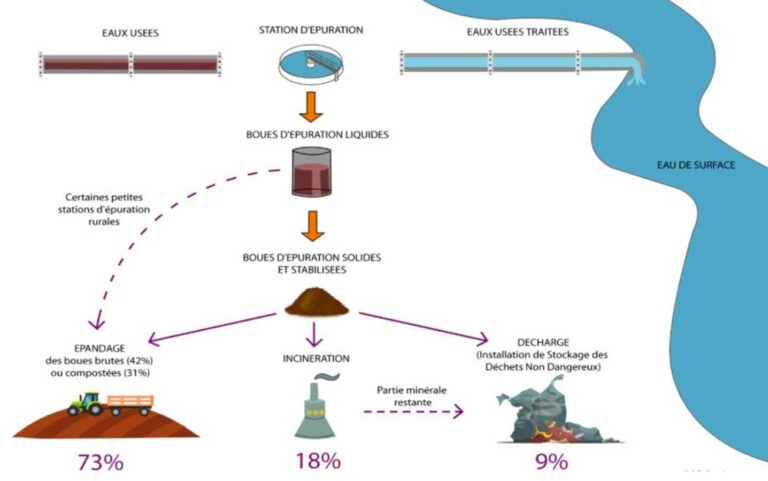
The problem with composting
On paper, this composting is perfect. Sludge is mixed with green waste. The green waste, by aerating this mixture, will favor the work of bacteria and turn it into a "noble" product intended to amend soils. However, to be virtuous, this process would require the green waste and sludge to be irreproachable. Which is far from being the case.
Green waste comes partly from waste collection centers, which receive a lot since burning was prohibited. This waste is not checked upon receipt at the waste collection centers. Therefore, waste soiled with everything that can be added during mowing and cutting arrives at composting plants. Plastic, rubber, ferrous and non-ferrous metals, tar, concrete, various dust, etc. When they arrive at composting centers, if the waste is to be used to make bagged compost for sale, it is freed of its "visible contaminants". Compost intended for agricultural spreading is often raw or poorly sorted and contains the waste mentioned above.
But other waste is allowed in the production of compost. Coming from pharmaceutical factories, leather and fur factories, chemical factories, cement factories, slaughterhouses, etc. The list is long. It's 10 pages long.
For sludge: the general public believes that it is only dried excrement. People ignore that in many wastewater treatment plants (with unitary networks), everything that passes through the sewers is treated. Excrement (which contains antibiotics, estrogens, and even viruses), laundry products, cleaning products, sink water.
But to these household effluents are added rainwater (with all that it contains), runoff water from roofs, parking lots, streets, street cleaning, floor cleaning in businesses, workshops, restaurants, etc.
And sometimes sludge from wastewater treatment plants of certain factories is added, and not only from agro-food factories.
Since Covid, the legislator has prohibited the direct spreading of sludge from WWTPs and requires hygienization. However, it still needs to be irreproachable. Which is far from being the case. These composts are very often produced naturally without heat input, so this hygienization is not always achieved, which does not allow the destruction of all "pollutants" in the finished product. Often the maturation is too short. To produce new compost and produce more, it ends up in piles in farmers' fields, weeks, or even months before spreading.
The foul odors emanating from these agricultural composts are the signature of a poorly produced product and are part of the population's rejection of these spreadings. Because well-made compost smells of nothing but earth.
A commercial compost bag smells good, a pile stored on agricultural land stinks. The production should be the same, but for profit, it is not.
It is these methods that have hampered the sector. Plus recent research that casts doubt on the safety of the product, even when standardized.
The transformation of sludge into compost is a lucrative activity, not a philanthropic act. The factories are very often subsidiaries of large groups, often active in water treatment. Fierce competition exists between them.
COMPOSTING OF SEWAGE SLUDGE (SEPTEMBER 14, 2021)
Article L. 541-38 of the Environment Code, created by Article 86 of Law No. 2020-105 of February 10, 2020, relating to the fight against waste and the circular economy (known as the Anti-Waste Law), provides that sewage sludge and sewage sludge digestates can be treated by composting, alone or mixed with structuring agents, provided that the operation improves the agronomic qualities of the sludge or digestates. This draft decree specifies the conditions for verifying the improvement of agronomic qualities.
Article 1 creates a new section in the Environment Code which defines the conditions under which sewage sludge and sewage sludge digestates can be treated by composting together with other materials used as structuring agents.
This section defines in a new Article R. 543-310 the different terms used, notably the notion of structuring agents and green waste. It imposes in a new Article R. 543-311 that structuring agents, sludge, and sludge digestates must comply, before composting, with the safety criteria in force applicable for the use of these materials on land through a spreading plan.
While Article 86 of the Anti-Waste Law generally introduces, with the aim of improving the agronomic characteristics of sludge and sludge digestates, the possibility of using other materials from plant matter as structuring agents on composting platforms, green waste as biowaste is primarily intended to allow the treatment by composting of other biowaste (food waste) or their digestates, whose source sorting must have been generalized by no later than December 31, 2023, by the public waste management service and private and public establishments.
Thus, it is therefore necessary to limit the quantity of green waste mixed with sludge in order to preserve the resource for the valorization of biowaste and thus be able to meet the requirements of Article 22 of Directive 2008/98/EC on modified waste.
The mass of green waste used in the mixture is limited by a new Article R. 543-312, initially to:
- 80% of the mass of sludge or sludge digestates used in the mixture,
- 45% from 2024
- 30% from 2027


